Thursday, November 17, 2016

Labyrinth Lord / Desolate North House Rules Part 1a: Thieves

As promised last time, I'm showing my re-work of LL's Thief class. This is all based heavily on the write-up already in Hill Cantons and inspired by Unfrozen Caveman Dice Chucker (I refuse to accept the new name).


Thief

Requirements: None
Prime Req: DEX
Hit Dice: d4
Maximum Level: None


Note that a Thief can be of any alignment. In addition to any bonus languages for intelligence, the thief also knows Thieves' Cant, an argot of Common used by ne'er-do-wells to discuss nefarious proceedings.

9th level hideout shenanigans are still possible as per LL.

At 11th level, a Thief's backstab does triple damage.

Thief Skills

Instead of advancing along a percentage table with level, thieves are awarded Bonus Skill Levels. These bonus skill levels can be assigned into any skill the thief chooses.

 Starting Thief Skills
Scale Sheer Surfaces:5, max 12
Pick Pockets:2, max 15
Find/Remove Traps:2, max 12
Pick Locks:3, max 12
Hear Noise:4, max 11
Move Silently:2, max 13
Hide in Shadows:2, max 13
Read Languages (at Level 4):0, max 13
Read Scrolls (at Level 9):5, max 12

In order to succeed at a skill, the Thief rolls a d10 trying to roll below the skill level.

Double 12: Every time you roll a 12, roll again. A double 12 is always a failure, regardless of skill level.

Thief Skill Definitions

Scale Sheer Surfaces: This is not just 'climbing walls', but scaling sheer surfaces, viz. things that a normal person would just say, "That's impossible." Examples include the sides of skyscrapers, windy overhangs with few to no handholds, etc. However, some surfaces might still be outside the thief's ability at the DM's discretion.
Pick Pockets: As per LL, except for each level the target is above the thief subtract 1 from the skill.
Find/Remove Traps: Also works with Secret Doors and other such. Note that the DM will still require a description of your activities, and decide success, failure, and difficulty based on this. This is not preternatural, and is in fact a thing all adventurers do; thieves are just better at it.
Pick Locks: As per LL.
Hear Noise: Not just any old noise, but preternatural hearing - noises you wouldn't otherwise be able to hear. Picking up whispered conversations through keyholes, hearing footsteps far away by putting your ear to the ground, that kind of thing.
Hide in Shadows: Anyone can hide, but it takes a thief to hide in shadows. Area must be shadowy and dim, and you cannot hide in shadows while being watched. (If the thief fails the check, it is assumed he is still being stealthy - though maybe not with success.)
Move Silently: Anyone can move quietly, but it takes a thief to move silently. Thief must not be wearing or carrying anything noisy (e.g. clinking bottles, non-magical armor heavier than leather), and there are certain environments that either give a penalty to the roll or may make it impossible (e.g. nightingaled floors, wading through water). If the thief fails the check, it is assumed he is still being stealthy - though maybe not with success.


Thief Level Advancement
Exp
Level
Hit Dice (1d4)
Bonus Skill Levels
0
1
1
0
1,250
2
2
3
2,500
3
3
4
5,000
4
4
3
10,000
5
5
4
20,000
6
6
3
40,000
7
7
4
80,000
8
8
3
160,000
9
9
4
280,000
10
10
3
400,000
11
+1 hp
2
520,000
12
+2 hp
1
640,000
13
+3 hp
1
760,000
14
+4 hp
1
880,000
15
+5 hp
1
1,000,000
16
+6 hp
1
1,120,000
17
+7 hp
1
1,240,000
18
+8 hp
1
1,360,000
19
+9 hp
1
1,480,000
20
+10 hp
1

******

I'm thinking of completely removing Find/Remove Traps in favor of just giving Thieves a flat 3 in 6 to notice secrets and traps when looking, and a note saying they're likely to be better at removing them than other characters. That skill in particular bothers me for all the reasons it's bothered other people more experienced and eloquent than I.

Tuesday, November 15, 2016

Labyrinth Lord / Desolate North House Rules Part 1: Character Creation and Classes

Inspired by a lot of people, including +Jeff Rients, +Peter V. Dell'Orto, and +Chris Kutalik, and
others. I'll try to include links to relevant posts/articles/whatever when I can, but if I forget or can't find it, that shouldn't be taken to mean I'm claiming to be the original author of the idea.

3d6 In Order. Few Exceptions.
The only exception here is noted by LL, where it points out you can trade 2 points down for 1 point up, with restrictions. Those restrictions are still in place. Further, you can only do this if doing so would allow you to play a class you wouldn't otherwise qualify for, not just to get your Prime Requisite into XP bonus territory.

Bonus Languages:
High INT score gives bonus languages as noted. However, these languages do not have to be chosen at creation. Instead, whenever a new language is encountered, the player may choose to roll a D6; on a result of 1-3, the character happens to know that language as a Bonus Language.

Languages can also be learned in play through other means.

Classes

New classes: None yet. But I might add some (like Battle Nuns).


Cleric:
I'd love to make clerics start with no spells at level 1, but that sounds exactly like the kind of modification to make players not familiar with the OSR grumble.

Clerics must be either Lawful or Chaotic. Lawful Clerics are Clerics of the Church (more on religion in the Desolate North later) and must be male. Players are encouraged to create sects or brotherhoods or orders to which their clerics belong.

Some Clerical sects (even within the Church) may have different weapon limitations.

Clerics are the only class to automatically know an 'alignment language' - which is the language of their religious proceedings. (In the Church, it's a Latin-analogue.) Well-educated monsters may or may not know an appropriate alignment language.

Clerics may create scrolls as per Holmes: usually 100gp and 1 week per spell level.

Dwarves:

Clarification: a dwarf hiring folks for the stronghold can hire dwarves for any job, though it may be hard to find a dwarven spellcaster. However, they cannot hire any other races as mercenaries or soldiers.

Elves:

Elves have no souls. This means they are immune to spells that directly inflict death or act on the soul; e.g. Ray of Death, Disintegrate or Trap the Soul, but not Prismatic Sphere. However, they cannot be brought back from the dead, either.

Elves can cast spells while using weapons, shields, and armor.

Elves do not have spellbooks. Instead, they gain (and can cast per day) spells as on the below table:


Elf Spell Progression
Spell Level
Level 1 2 3 4
1 1 0 0 0
2 1 0 0 0
3 2 0 0 0
4 2 0 0 0
5 2 1 0 0
6 2 1 0 0
7 2 2 0 0
8 2 2 1 0
9 2 2 2 0
10 2 2 2 1

Spells gained are usually randomly determined, though there may be exceptions.

Elves may create scrolls as per Holmes: usually 100gp and 1 week per spell level.

Fighters:
Fighters with DEX 16 or higher may Parry, sacrificing 1 attack per round to give themselves -2 AC.

Fighters get +1 to their hit dice at 1st level, so a 1st level fighter is 1+1 HD.

Whenever a fighter kills a foe with a melee attack, he may immediately melee attack another foe in range. Each new attack is at a cumulative -1 to hit.

Fighters start gaining bonus attacks at 10th level instead of 15th.

At 4th level, any time a Fighter rolls a natural 20 to hit, it hits automatically and rolls max damage. Note that no other class gets critical hits.

At 8th level, a Fighter's damage dice explode. The max damage from a critical hit counts for this purpose.

Halflings:
Halflings may only carry 1 Large Item, and it counts as two. (See house rules for encumbrance here.)

Halflings are universally bald, and they have a parietal eye. Whenever their heads are uncovered, they receive a +1 to saving throws from threats from above at the DM's discretion. When forced to wear headgear they feel distinctly uncomfortable.

Magic Users:
A Magic User starts play with 2 1st-level and 1 2nd-level spell in his spell-book. All other spells must be gained in play. (Not a change, just a note.) One of those spells is Read Magic; the other two are randomly determined. (Not everyone gets Sleep and Web.)

Magic Users may create scrolls as per Holmes: usually 100gp and 1 week per spell level.

Thieves:
Thieves effectively get a complete re-write, based on the alternate thief skill rules from the Hill Cantons and then further modified by Timrod. More detail follows in another post; it's too big to throw here.

Thursday, November 10, 2016

Starter dungeon for the Desolate North

While I have your attention, can I point out for a second that it feels weird to have a buffer of posts? I'm writing this about two weeks before you'll see it. Anyhow...

I've finally completed my first real attempt at a dungeon. A mega-dungeon it is not. It only has one level, and will not get a standard party of 5 level 1 adventurers up to level 2 even if they find all the treasure (OK, that's a bit of a lie given the special items.)

I'm posting it here because
  • It might be useful to people who want to run it, though I seriously doubt that
  • It might be interesting to people to see a newbie post his work, either for historical or analytical reasons
  • (Most important) I'd love feedback from people with more experience than I about how I can do this sort of thing better. It was a lot of work, though ultimately fun.
Given that this isn't a mega-dungeon, I eschewed all normal 'random' stocking rules in favor of going with the theme of the place and the world. It might be terribly unbalanced. I don't know.

Outside The Setup portion, which isn't in my notes at all (doesn't need to be), I'll be writing this up exactly like it is in my notes. The exercise is show and tell, for the reasons listed above, not 'clean this up for production'.

The Setup

Production has stopped at the salt mine that was the principal reason for the founding of Queen's Landing. The overseer cannot get the slaves back into the mine - they simply won't go. A few days back, a section of the mine floor collapsed into a subterranean cavern underneath, and several of the nearby prisoners swear they saw some hideous man-things come up out of the hole, grab two of the miners, and escape back down it in the confusion.

There are indeed two missing prisoners, though the overseer thinks they just used the confusion as an opportunity for escape. (A search has been mounted, but the general feeling is that if he shows up in town he'll be caught, and he's welcome to try surviving in the wilderness. Prisoners have escaped before; they usually die anyway.)

Regardless, the miners won't mine. They're spooked by the rumours, and if the prison staff tries to force things, they might fall into open revolt.

The Lord Steward Merriweather has put out a call for any adventurous wild-cat sorts who want to check out the collapse and see whether things are safe, and on the off chance that they aren't, make them so. He's offering 25gp worth of town scrip, because this is supposed to be just a cake walk. If it turns out there's something serious, well, you can keep what you find down there, and taking care of the problem will earn the town's gratitude.

(If nobody decides to take the job, production will start again in a few months after the staff get some reinforcements and clear out the place themselves. But the town will suffer and go down 1 market category or whatever system I decide to use, as production will be slowed for a year until staff gets back up to strength.)

Assuming the PCs take the job, they'll be escorted through the salt mine to the hole in the floor, and

The Saltmine Dungeon (or Ast Knarveth)

Click to embiggen. Grid didn't scan; little rooms are 1x2

Monsters

(1)   MuDwarf Patriarch (as ogre)
AC 4 HD 4+1 HP 26 #A 1 D 1d10+2 M 30' Save F4 ML 10
Hideously mutated, unintelligible gibbering, very strong
always w/ 2 LTs
Uses dwarven ax silver-inlay w/ emerald pommel & maker's mark (picture in notes) 300gp

(2)    MuDwarf LTs (as hobbo) ML9 AC 6 1d6 (bone spears)
AC 6 HD 1+1 HP 6,8 #A 1 D 1d6 M 30' Save F1 ML 9
Always w/ Patriarch
Dwarf-sized chain badly misfit, old, rusty
Matching (1 each) ruby-silver earrings, 100gp each

(20)    MuDwarves (as orc) ML7 AC 8 (tough skin, rags) 1d6-1 (bone spears, clubs)
AC 8 HD 1 HP 4 #A 1 D 1d6-1 ML 40' Save F1 ML 7
Carry worthless trinkets & fetishes made of bone, stone, rags
3 (roll randomly) have small, dirty gems in their trinkets 1d6x50 each

(6) Skeleton warriors (room 4) ML 12, Save F1, AC 7 (bones, naked) D 1d6 (fists)
Remains from early deaths. Triggered by messing w/ remains.

Wandering Monsters
When players enter dungeon, roll 2 x 1d6


Patriarch Others
1-3) in room 9 w/ LTs and most others 1-2) all in room 9
4-6) in room 1 w/ LTs & 1d6 others worshipping/rutting 3-4) 2 on patrol in r 1d6
5-6) Dispersed
posted in:
r1) 2 on lookout near corridor
r3) 4 in r3 on lookout
r5) 1d8 rooting around

If wandering monster check succeeds, that means 1d6+1 MuDwarfs stumble into party as per normal rules. Subtract from total (20)

    Roll reactions. On low rolls, will probably try to alert others. Not stupid.

Rdescs

(Editors note: Room Descriptions)

Air very musty everywhere

1) Natural cavern. Mine collapsed ceiling. Salty rubble everywhere.

2) Old storeroom. Dusty, ancient cobwebs. Some barrels/boxes so far gone it's just a dried-out mess w/ hoops of rust.
    Recent footpath cleared across floor.

3) Kitchen. Complete disarray. Pans/post mostly rusted away. Food scattered & so old it stopped rotting long ago.
    Careful or you make a noise.
        If players spend 2 turns digging, find ancient jar of 'old man's feet' - fungus spice, ~ 200gp

4) Rudely carved crypt w/ dwarf remains tucked into niches and some bones scattered about.
    Bodies jointly contain tarnished/hard to find jewelry & talismans worth 150gp
                               show ancient dwarven lineages, sage would want

Messing w/ corpses causes 6 (dwarf) skeletons to rise
           (6) Skeletons: HD 1 HP 4 AC 7 #A 1 (1d6) Save F1 ML 12 Move 40'

5) Great Hall. Lots of furniture, mostly broken up. Rags, stains everywhere. Old fireplace on W wall.

On south wall, old china cabinet intact. Covered in dust/age, so hard to judge. But made of rare wood, still in good shape 550gp
    Lots broken, but 2 intact china plates: 100gp
(Margin note: Covered in shit. Mudwarves shit here.) (Editor's note: Never claimed to be a family-friendly blog.)

privy has nothing, just old shit

6) Entrance hall. Old rotting tapestries in mouldering piles. Piles of rust and rubble.
6a) (Editor's note: designation added after scan, this is the main room west of 6) Barbican. Bare, collapse west prevents exit. N is old gaol w/ ancient bloodstains (actually rust - manacles & bars are no more). 1 man at a time through entrance.
    Dust trail to 8.
  S is old guards' post. Bare.

7) Guest room. Powerful smell of ancient rot (doors never opened) Nothing of value

     S) Secret door @ end of hall only opens from this direction. Simple rotating wall (push to open)

8) Alcove holds a well (still good! but stagnant) Impressive stonework

Faint smell of moisture. Most of west room covered in dried mold (no effects)

Foot trail to 9

9) MuDwarf Lair. Wset portion collapsed in rubble. Monsters usually here.
Reeks of close bodies & alien musk. Rags & bones & confusion everywhere, clumped into old piles. Everything soiled.

One pile larger than the others: MuDwarf patriarch keeps treasure here, including Book of Records

Treasure:

6 gems
Star rose-quartz250gp
Fire opal (roll-cut1000gp
(in LT bundle) Jasper250gp
(in LT bundle) Lapis Lazuli50gp
(in LT bundle) Rock crystal250gp
Onyx75gp (Total 1875gp)
Book of records (see elsewhere
500ep (small sack)
Set of silver (2 forks, 4 spoons)200gp
3 mithril ingots750gp
Scroll (Sleep, Hold Portal, Arcane Lock)Total 4875gp
Treasure map to lvl 1 of megadungeon (P's old quarters, for 3000gp)

10) Halway to quarters. Pillar is loadbearing.
Each room: complete disarray. Low stone shelf held mattress. Everything torn/soiled/scavenged by MuDwarfs.
Search for 1 turn: 5% chance to find coins/trinkets worth 1d6x25gp. One search only

S door locked, diff 9

11) Shrine
    Fouler smell here than anywhere.

Gruesome stains everywhere, broken masonry
NE corner holds dais long since w/ statue smashed off

SW corner holds bloody altar on low steps.
Altar has remains (gore, arms, legs) of the 2 missing miners. Also holds Black Orb (see below)

Black Orb: Responsible for dwarves surviving & mutating. Seamless, slippery sphere that "glows" w/ blackness. Strangely attractive.

If PCs keep it, town starts to go weird, and it will whisper visions of megadungeon & other places.Wizard tower will show.

If PCs sell it (sage), will gain 1000 gp (haggle) & wipe out sage. Town (& sage) will go weird, wizard tower will show.

If PCs give it to Church, will gain much favor there & w/ town. (Marchand) Town will not go weird & nasty.

Book of Records: Written in High Qellem (ancient Dwarf) by Parakel (Patriarch) of founding of Ast Knarveth (this place). Describes old Mon Daerdul (megadungeon) & passable directions (in form of 'we traveled from').

Starts normal - years pass, place grows, births & deaths - but slowly becomes obsessed w/ "Godsphere".

Chronicles sealing in, & attempts to get out. Notes strange survival w/o food, and growing comfort. Abandonment of efforts. Descent into madness & barbarism.
Last entry crude & centuries ago.
Bound in old cracked leather. Vellum. Worth 3000gp to sage.

*****

That's 4875gp in treasure, plus a Scroll and Treasure Map. If the party sells the book and orb, that's another 4000gp - for 875gp over the amount needed to go up to level 2 for a party of 4. (Though selling the book and orb won't directly grant XP in my game.)

I think that's accurate for my intent. I don't want the characters to level up off of this place; instead, I want to give them a small taste of dungeoneering and reveal the existence of the megadungeon (which will be a few days' travel away from the town), along with a sense of the Weird.


Tuesday, November 8, 2016

Battle Nuns: a LL or B/X class

Thanks to +Thomas Pluck (here) I give you:

Battle Nuns
Nuns of the Supernal Sisterhood of the Hunting Rifle.

Requirements: ST 9
Prime Requisite: WIS
Hit Dice: 1d6
Maximum Level: 12
Alignment: Lawful
Save: as Clerics
To hit: as Fighters

Battle Nun Level Progression
Experience Level Hit Dice (1d6)
0 1 1
1,501 2 2
3,001 3 3
6,001 4 4
12,001 5 5
24,001 6 6
48,001 7 7
96,001 8 8
180,000 9 9
260,001 10 +3 hp only *
300,001 11 +6 hp only *
440,001 12 +9 hp only *
*Hit point modifiers from constitution are ignored


The first Order of Battle Nuns was started five hundred years ago back when the Church was aiding the Kingdom of Nurian to fight off the Qynari heathens. After years of bitter fighting against their necro-melded  armies, the Qynarate held the upper hand. They were poised to sweep over Berthold's Pass and into the Nurian heartlands, whereas the Nurian-led coalition army was mostly put to flight in a previous battle, leaving only a small handful of defenders to hold the pass and keep the enemy at bay.

With the defenders was a 12-year-old peasant girl named Therese Olon. (Olon was a nearby village.) On the day of the battle she stood forth, and eyewitness accounts say she was filled with the Light of Salvation and, wielding a mace made for a much larger man, enabled the defenders to beat back their gruesome enemy, thereby saving Nuri from certain destruction.

After the battle, Therese went on with the army for another four years, culminating in yet another victory and the sacking of the Qynari city of Akarim Gel, thus putting an end to the threat. In the last battle she was fatally wounded, but she had gained a following of other women and girls to carry on her legacy.

That following became the first Order, the Sisters of Unfailing Humility. Therese was canonized and the Order recognized by ecclesiastical authority a mere ten years afterward.

All Battle Nuns are members of one of the militant female orders of the Church. Examples include the Little Sisters of Mercy and the Most Humble Daughters of Her Supreme Mitre.

Orders of Battle Nuns specialize by weapon type. A Nun of a particular Order may only use weapons of that Order's chosen type, which must be decided at character creation. (Players are encouraged to create Orders to which their Nuns belong.) A Battle Nun may use any sort of armor, but no shields.

A Battle Nun gets some recompense for her restriction in weapons. At level 3, her weapon counts as magical for the purposes of damaging enemies that can only be hurt by magical weapons.

At level 6, a Battle Nun rerolls any 1's she rolls for damage with her chosen weapon. If the new roll is also a 1, it stays.

Turning Undead: A Battle Nun may Turn Undead as a Cleric 2 levels lower.

Reaching 9th Level: On attaining 9th level, a Battle Nun may establish or build a convent. So long as the nun is currently in favor with the Church, she may buy or build a keep at half the normal price due to ecclesiastical intervention. Once a convent is established, the nun's (now abbess') reputation will spread and she will attract 1st and 2nd level followers of the Battle Nun class (numbering 5d6 x10). They are completely loyal (never checking morale).

Thursday, November 3, 2016

Switching sytems (again): LL/BX incoming

Last post was about a bunch of things that have gotten in my way to playing recently.

One of the things I didn't mention was Swords & Wizardry not lining up well with everything I wanted.

Don't get me wrong; it's a good system. You can start playing a game in 15 minutes if you have even the most casual experience with D&D, and all the parts are well-fitted.

But it's missing a few things. Specifically, the things that bothered me the most were a lack of morale rules, reaction rules, and a lack of explicit support and guidelines for domain or hex-crawl play.

Those are both easy enough to get around. Higher-level play guides abound across the OSR and are largely agnostic about the exact system. And I could just steal ML scores off of a different version.

Ultimately, however, it got to be one of those roadblocks I was talking about. I wanted to go through the monster selection and add in ML scores in-line, rather than having to look them up or just wholesale use stats from somewhere else. I wanted to splice in rules for henchers/retainers/whatever. I wanted to do a few other things, and it added up to a bunch of work.

Add in that LL/BX is (are) probably the most popular system in the blogosphere, meaning you have a bunch of (admittedly low-effort) conversions if you want to use most things out there, like new classes or spell ideas or whatever, and there's a fair bit to be gained by switching over.

There were some things that were keeping me back. Primary among them were the level-system expansion from 10 to 20 levels, split saves, to-hit matrices and race as class. I'm over these, now.

I like 10 levels. It's nice and clean and doesn't bog down higher-level play. I might even keep it; PCs don't gain much by getting higher level. Or I might cut it off at 15. Ultimately, though, it doesn't really matter; levels in the double digits rarely actually happen anyway. It's certainly the end-game, and I can treat it that way while still throwing you a sop for going out adventuring. Or you can retire.

Split saves are kind of a pain. They're a little silly, too, in that they don't necessarily match up well with categories that would be useful in play. That said, they're also a little attractive; there's something 'traditional' about the system. Plus, unlike with a unified save number, you won't forget you have a +2 against poison. At least, not usually.

Related to that is the fact that in LL/BX monster saves are written as 'F3' or 'C1' or whatever. This means I have to look it up on the table. That's not as big a deal as it felt at first, though; the tables are small and easy to read, and I can excise them instead of flipping through the book for them.

The big objection is Race As Class. This was a full-stop no for me for a good long while. Recently, however, I've been re-thinking things, and it doesn't seem that bad. The race/class system with multi-class elves and the like is a little clunky anyway. It's still a little weird, but I'm willing to give it a try and see how I like it.

To recap:
  • Switching over gives me a fairly large set of advantages with low cost. I can more easily use a broader range of material, and it obviates a good set of work I wanted to do to make S&W more to my liking
  • Plus, I have the B/X books, so I can compare and decide in any given case. (I also have the LBBs, but S&W is much more different from those than LL is from B/X, and they're hard to read.)
  • There are some obstacles that were previously keeping me from seriously considering LL, but I'm over them.
If you've made it this far, you've earned an Otus Tax.

Vegepygmy is best pygmy

Tuesday, November 1, 2016

Things keeping me from playing and how to get around them

I've been giving this a fair bit of thought lately. I like gaming, a lot. Yet it has been a few years since I had a regular group, and that was a couple (great fun, but) sadly abortive attempts back in Wisconsin that only lasted a few sessions before I had to move.

That was years ago now, though. Why don't I still have a game? I have a few roadblocks:

  1. Grad school. This one's new, but it's a bear. I'm now devoting the lion's share of my time here.
  2. Other hobbies. Most of these are things like video games and other computer-based past-times.
  3. Creation is stressful. I get fired up about ideas for things in play, but actually putting pen to paper and drawing up maps, keys, encounters, and even just descriptions is emotionally draining, rather than restorative. This is especially a problem because of #1 meaning I need restorative time.
  4. Setting. I want my own homebrew setting with its own set of things that make it unique. This is one of the things I love about DMing. Unfortunately, coupled with #3, this can be a lot of work to pull off.
  5. Regardless of everything else, recent moves mean I don't have a group.


That's a fair list. There's probably other stuff involved too, but that's the most of it.

#5 is the most important. I need to start advertising that I'm interested in playing a regional game and put together connections for folks who might be interested in giving mine a try. This should be easy once I know some people in the area, especially because I like inducting completely new players. (They don't come with preconceptions about how D&D should play.)

For #1, there's not much I can do. Grad school is grad school, and it's more important than gaming. It also takes up a large amount of my time. However, maybe I can work around it.

Instead of shooting for weekly sessions, I could go for one every two weeks, maybe one a month. Generally I get uncomfortable with this level of play, because it saps engagement from the players (and me) and it takes forever to get anything done. One way to get around this (if I can find a group) would be to run my game parallel with another DM, either as a co-op (long ways away, that) or on an alternating schedule. That could work.

For #2, something's gotta give. If I want to run a game, I need to dedicate some time to it. Plus, I probably should spend more time with the wife anyway. I'll think over some way of restricting my (non-work) computer time. Probably a schedule with a once-or-twice-a-week acceptable computer day... or something.

#3 is tricky. I am under the impression that most members of the OSR don't share this problem, and that for you guys creation is a restoring outlet that you go to to recover from the stresses of the day.

I've never really created a lot of dungeons or encounters. While I was a 'GM' for a long period of time in middle- and high-school, it was for a one-player over-the-phone game. I'm fairly good at improvisation, so coupled with a few GURPS Fantasy Yrth modules (Orcslayer anyone?) and a focus on overland travel and social interaction I very rarely got out the graph (hex) paper.

Part of the problem is also that I tend to aim too high. I want a cohesive idea to my dungeon, and that comes with specialized random encounters that draw from the local population and detailed faction maps and careful room descriptions and asking myself if this map makes sense for an old stronghold and where the privies are and how the denizens eat and and and and and... which might be great if it didn't keep me from getting things done. Finished dungeons with holes and static encounters are better than a bunch of really cool half-finished ideas.

I'm hopeful that setting myself some basic goals and meeting them will help with this. I mean things like 'This week we're going to create a three-flour dungeon with ten rooms on each floor,' or, 'Make a four flour dungeon with fifty rooms on each floor; you have to complete at least two rooms a day.' For one, this will get it done regardless of stress, if I can bring myself to prioritize it. Secondly and more importantly, I suspect this is the sort of thing where practice makes it less stressful. You probably learn to go faster, feel easier, and not sweat the small stuff.

I think I'll set myself a goal: I have a megadungeon with a side drawing already worked out. I want to get at least the first level and part of the levels above and below drawn and stocked before I begin play, since this may very well be the tentpole dungeon of the setting. In an upcoming post I'll outline my goals for this in detail with deadlines, and give a brief overview of the concept.

#4 has been a major stumbling block so far. The Desolate North setting I've been (oh-so-slowly) developing in this here space is my choice for a homebrew. I'm not exactly satisfied with it, though, which has retarded work.

For one thing, hexcrawling through wilderness is fun, but so is over-arching political tension. Native settlements, other towns (with the possibility of re-basing the PCs if they so desire), skirmishes, wars, and the like are fun. I want the world to feel alive. Unfortunately as originally conceived, the Desolate North wasn't really set up to support that. It was based on an Arctic Circle feel, which just doesn't leave much scope for the population necessary for frontier geopolitics. I've changed that by lengthening the growing season, and I'm shifting the 'feel' of the place from Alaska or Antarctica to Central Asia (with a touch of Siberia and Alaska still). I still like the cold, but I want more people.

For another, a homebrew setting makes it difficult to take tings whole-cloth from other sources, especially if you have design goals like 'no goblinoids.' Something like that is fun to think about - it helps make your place unique - but something needs to replace orcs or all your dungeons will be empty. Which means you have to work that up, with little help from established TSR/WotC support and modules.

Finally, I aim high here, too. For making my own setting, I want custom encounter tables, a grand sweep of history, hidden mysteries, fleshed-out cultures, etc. My first inclination is to go all M.A.R. Barker on the thing, but then creation-as-stress comes back to bite me.

I'm not yet sure about my solution for The Orc Problem. Probably what I'll do is keep them entirely and just call them something else with an aesthetic reskin. Men of some sort; maybe they're neanderthals or savage elves or mutated dwarves or whatever. Or maybe I won't, and I'll have orcs and goblins (but seriously, cut back on the huuuge proliferation, Gary; we don't need hobbos and buggies and and and) but have something different about them.

My solution to overcreation, thanks yet again to +Chris Kutalik over at the Hill Cantons, is to enforce on myself bottom-up creation. Have an idea for a setting element? It goes on an index card and you stuff it in a binder. Once you have players, then you can play around with the setting elements as they explore them.

Beyond that, I've set myself a strict limit: all I need to begin play in the Desolate North is the town of Queen's Landing (now done), a starter dungeon (nearly done), house rules (basically done), 30 rumours (without bothering with true or false), and a hundred rooms or so of the tentpole dungeon. At some point soon after that, I should put together a DM hexmap.

Which I guess means it's around time to start soliciting players...

The fifth and last problem is the easiest to solve. I just need to meet some new people, and either find a local group or put one together. That just means finding and devoting the time. Once the rest of these problems are solved, it'll be easy.

Afterward

Whew, that was much longer than I intended. I guess when I have something to say I really can write a large amount in a single sitting...

For the three of you who've made it down this far: have you faced similar problems? If so, how do you deal with them? If not, what kinds of problems do you face as a GM?

And do you know a gaming group in the DC metro area looking for another member?

No relevance

Friday, October 28, 2016

Layout and notable NPCs of Queen's Landing

Disclaimer: when I started this post I was still under the influence of The Village of Hommlet. I should like to think I've shed that now, for the better (sorry Timrod), but you'll still see the influence in wordiness/stats/treasure write-ups for some of these NPCs. Frankly, that level of useless overproduction is most of the reason this post didn't get finished two years ago.

With that in mind, I give you:

Layout

Queen's Landing is that rarity of medieval settlements: a planned town. It was erected by penal labor and has orderly rows of streets and buildings, though the edges are a bit busy by now with the new population.

The town walls form a rough square on three sides, projecting into the bay to protect the harbor both as a seawall and from attack along the beach. The fourth side is open to the bay and comprises the harbor, with 1 quay large enough for blue-water shipping and several other piers for fishing vessels

A section of the palisade

The Law


Lord Otto Marchand, governor of Queen's Landing
AC 3 (chain and shield +1), F4, hp 27, D 1d8+1 (longsword +1) ML 10

At 67, Lord Marchand is getting on in years. In his youth he played a prominent part in the Saxonid Wars, but he's no longer as strong as he once was. As governor of Queen's Landing, his word is law. (Anyone of noble blood would be able to write a petition to the King to protest a decision of his, but no noble not of the Marchand family has ever set foot in Queen's Landing.) He spends as much time as possible in Albilonia, so is usually only in Queen's Landing for the summer months. On his person he always has his signet ring, a gold ring with an emerald worth ~1,000gp to the right buyer. (219gp if melted down with the emerald prised loose.)

When here, he takes up residence in the Governor's Quarters. This large log building is in the center of the town and has its own palisade, plus a garrison of 10 men (AC 6, F1, HP 6, D1d8, ML 11) led by a Sergeant (AC 4, F2, HP 11, D1d8, ML 11, silver pin of office worth 20gp) and a Lieutenant (AC 4, F3, HP 11, D1d10, ML 11, gold pin of office worth 110gp) wearing the green and gold crow livery of House Marchand. People come and go on official business a fair amount, and for an appointment you can just approach the gate. These men are men of House Marchand, not the guard of Queen's Landing.

With Lord Marchand are his wife and three daughters, along with his only son, Adam Marchand, 11, who will likely become Governor of Queen's Landing upon his father's death. He keeps them all in style appropriate to his station, and anyone ransacking the compound would come away with 10,000gp worth of miscellaneous loot, much of it recognizable.

Jordan Merriweather, steward
AC 9, hp 2, F0, D 1d4 (knife), ML 5

Jordan Merriweather, 54, is the chosen steward and castellain for the Marchand family. Matters too unimportant to bother Lord Otto come to him for resolution. The position has rather gone to his head, and he sees his purpose more as seeing that the Lord doesn't get bothered than resolving problems. He lives by himself in snug but nicely appointed apartments directly across from the Lord's Manor, and he doesn't go out much, feeling constantly buried under paperwork and minutiae, most of which he creates for himself (albeit unconsciously).

Merriweather is also in charge of the local 'bank' that pays in salt-cakes (or, more often, scrip representing salt-cakes), which are the only accepted currency in the town, by fiat of the Governor. 'Real' money or other valuables can be exchanged at fair and posted rates.

In practice Merriweather is seldom directly involved, leaving such things as the actual trading to a few clerks and scribes running an office attached to the inner wall. This also involves a rather large storage warehouse where goods brought in by the townsfolk and villagers in exchange for scrip wait until they are moved to the docks warehouse for shipping back to Albilonia or sold to others in the town.

The only thing of value he keeps on his person is his ring of office (silver, worth 44 gp) and a jeweled dagger (nonmagical, worth 233 gp). Were someone to break into his abode and ransack it, they could make off with 1,000 gp in rugs, tapestries, furniture, etc.

Boris Borisson, Captain of the Guard
AC 4 (chain + shield), hp 14, F2, D 1d8 (longsword) or 1d6 (xbow), ML 9

Boris is the Guard Captain of Queen's Landing, in charge both of defense of the walls and keeping the peace. He answers directly to either Lord Marchand or Mr Merriweather and has a decent working relationship with both. Folks on his good side can hear stories about his veteran days in wars down south before he took the King's Commission for Queen's Landing. Under him are twenty men of the Guard, including his Lieutenant, two Sergeants, and twenty-two Guardsmen. Usually busy, unless the PCs have something really pressing, and relies on his LT and sergeants for most grunt-work.
Gold pin of office worth 100gp

Mikhael Gunderssen, Lieutenant of the Guard
AC 4 (chain + shield), hp 7, F1, D 1d8 (longsword) or 1d6 (xbow), ML 9

Boris' right-hand man from waaaaay back. The two are old campaign buddies, and when in their cups will regale listeners with war stories from the south. Otherwise, Mikhael is an accomodating but no-nonsense guardsman who just wants to see things flow along with little trouble and an eye toward the security of the established townsfolk.
Silver pin of office worth 25gp

Sergeants (2)
AC 7 (leather), hp 5 each, F0, D 1d6, ML 8

One is usually on gate duty, the other patrolling or dealing with things in town. Usually with 1-2 other guardsmen. Spear, shortsword, and xbow. Will also carry truncheons (1d4) for breaking up disputes.

Guardsmen (22)
AC 6 (leather + shield), HD 1d4+1, F0, D 1d6, ML 8

Usually 7 on the walls (1 @ each corner, 1 along the length), another 3 at the gate, 2 on patrol through the town (w/ a sergeant), and the rest off duty.

Night shift has 6 on the walls, one watching the docks, and the gate is closed.


Townsfolk


Tully Kivversen, ostler of the Mermaid and Mouse and shopkeep of the Seal's Knees


Tully and his wife Anna run the Mermaid and Mouse, Queen's Landing's only licensed tavern. During the day, they also staff the general store, the Seal's Knees. Tully closes it up by drinking time, usually around three or four o'clock.

Tully is an influential citizen in Queen's Landing, and well-liked by just about everyone. He's taken to his role as a kind of peacekeeper and facilitator. For many people with a problem, Tully is the first and last stop. He came to Queen's Landing 10 years ago after a fairly long career in the southern border wars Albilonia fights perenially with the Qynarate, one of Queen's Landing's few voluntary colonists.

The Seal's Knees provides pretty much everything an adventurer could want for general goods, but since most of the wares are imported, they cost 20% more than the listed price. Notably lacking are any forms of arms or armor, but if you want tents, rope, rations, lanterns, etc. this is the right place.

The Mermaid and Mouse is a fairly large building on the two-story log-house plan. Downstairs is all one large common room, capable of comfortably holding upwards of fifty people. As such, it's not only a good place to pick up rumours if you're willing to buy drinks, but an adventuring party can usually find 1-4 non-combat supporters in any given week for about 10 gold each per day. On a 1-2 on a six-sided die, a man-at-arms may also be found if you're willing to part with 50 gp per day. Doubling the offered amount doubles the prospects and/or number of potential followers.

Upstairs are five rooms to let, one of which is occupied on a long term basis. Rooms can be had for 2 gp per night. Also available is a common sleeping area, mostly used to house drunks who can't walk home or who live outside the gates after they've already been closed for the night; a pallet here costs about a silver piece.

Tully, Anna, and their two children live upstairs as well in private apartments; during tavern hours, Tully keeps everyone else upstairs out of the way of the customers and hires serving boys to wait on tables and pot-boys to run the kitchen. Three or so can usually be found after hours sleeping in the common dorm.

The Mermaid and Mouse serves decent fare at decent prices; a home-brewed ale can be had for 5 coppers and is the most common drink. Imported ale (of the hoppy variety) costs a silver, and a bottle of Albilonian wine will run you anywhere from 1-5 gp, depending on quality. Harder spirits are usually only available during the summer, and can get fairly expensive. Fish stew is the main victual, and a bowl can be gotten for standard meal prices, with more exotic food involving a commensurate increase in price.

(See? This right here? This is what I meant by the Hommlet influence. Moving swiftly along...)

A nearby street in the summer


Delightful Meg

Meg is the forty-something proprietress of Kissing Nelly, Queen's Landing's licensed whorehouse. If you want to have some fun or just take the pressure off, Meg's your girl. Or rather, one of her thirty girls is. Kissing Nelly also serves drinks, but everyone agrees they're inferior to the Mermaid and Mouse's stuff. Even Meg, who doesn't want to step on Tully's business. She's in good standing with the guard and most of the men in town have visited at least once.

Delightful Meg is the woman to talk to if you want to know the rumours around town; as the town's madam she knows all the news.

Aksar the Omnipotent (or Aksar the Egghead, or Akshorty, or Aksar the Bastard, etc.)
Sage. Major area: Dwarven history.
Minor areas: Elvish legends, Underground agriculture/husbandry
Consultations are 100gp, 1/week

Aksar is a bespectacled, ink-stained dwarven sage. He specialized in ancient and obscure dwarven archaelogical history and coming off mad as a loon. He's convinced - convinced - that there was once a dwarven civilization in the Spine of the World before what he calls the 'Great Opposition' that 'created all the ice and snow.' His theories have earned him a reputation as a cook and a laughingstock, and he's in Queen's Landing because there's just no place for him in Albilonia anymore. (He tells himself he's out here on an indefinite-length expedition to prove his theories.)

He's cranky and obsessive, and prone to be brusque or downright rude to someone boring him and taking up his time, but he'll light up like Christmas and talk your ear off if you get him started on his pet subject.

His Excellency of the Sub-bishopric Tertiary of Queen's Landing Terrence Grayling


Generally venal and more interested in the world than God, though he puts on a good face on Lordsday. Not evil per se, but definitely not a good priest, either. Not a Cleric, and technically a Bishop of the Church, Bishop Grayling is hyper-conscious of his rank, not the least because the 'cathedral' is really more like an oversized parish church and he only has two other priests in his diocese. Likes to eat and drink. Has even gone to Meg's on occasion, when he thinks he can get away with it.


Nevertheless, he takes his job seriously; he just thinks of it as a job, instead of a calling. He will also gladly sell holy water, though of course it's not being sold, the PCs are just generous with donations!

Robert Crae

Robert, looking about thirty, runs the one and only smithy in Queen's Landing that will deal with arms and armor. He doesn't make swords, or plate, but he'll turn out or repair most anything else. He's shy enough to be almost mute, so anyone doing business here is probably going to deal with his apprentice Timothy instead.


Harbormaster Gerald Fitz

Gerald is a rail-thin man of about 70 with scraggly hair and a huge beak nose. He's an officious busybody, full of his own (actually rather minor) importance as THE harbormaster of Queen's Landing, which means he's THE man all the stuff to and from Albilonia goes through. A penny-pinching, sour-faced and sour-minded wheezy git who has a soft spot for Tully's wife Anna.

Rounding up and out

In total, Queen's Landing has about 1,000 souls, of whom 200 or so live and pursue trades inside the walls, with the rest being hetmen, farmer, hunters, a fair number of fishermen, and so forth comprising roughly eight square miles of settled land.

About four miles away (within sight from the walls) sits the salt mine and its compound consisting of about a hundred workers (half of them guards) and two thousand indentured criminals working off their sentences. They're fairly self-contained, with on site bunkhouses, mess halls, a farm, chapel, and so forth. Once a quarter Merriweather's men collect a shipment of around 100 tons of rock salt.
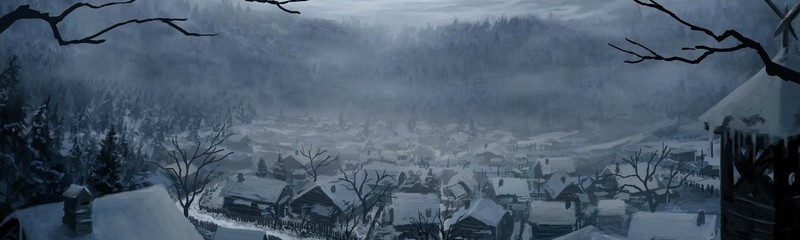
A view over the town in winter