Showing posts with label NPCs. Show all posts

Friday, October 28, 2016

Layout and notable NPCs of Queen's Landing

Disclaimer: when I started this post I was still under the influence of The Village of Hommlet. I should like to think I've shed that now, for the better (sorry Timrod), but you'll still see the influence in wordiness/stats/treasure write-ups for some of these NPCs. Frankly, that level of useless overproduction is most of the reason this post didn't get finished two years ago.

With that in mind, I give you:

Layout

Queen's Landing is that rarity of medieval settlements: a planned town. It was erected by penal labor and has orderly rows of streets and buildings, though the edges are a bit busy by now with the new population.

The town walls form a rough square on three sides, projecting into the bay to protect the harbor both as a seawall and from attack along the beach. The fourth side is open to the bay and comprises the harbor, with 1 quay large enough for blue-water shipping and several other piers for fishing vessels

A section of the palisade

The Law


Lord Otto Marchand, governor of Queen's Landing
AC 3 (chain and shield +1), F4, hp 27, D 1d8+1 (longsword +1) ML 10

At 67, Lord Marchand is getting on in years. In his youth he played a prominent part in the Saxonid Wars, but he's no longer as strong as he once was. As governor of Queen's Landing, his word is law. (Anyone of noble blood would be able to write a petition to the King to protest a decision of his, but no noble not of the Marchand family has ever set foot in Queen's Landing.) He spends as much time as possible in Albilonia, so is usually only in Queen's Landing for the summer months. On his person he always has his signet ring, a gold ring with an emerald worth ~1,000gp to the right buyer. (219gp if melted down with the emerald prised loose.)

When here, he takes up residence in the Governor's Quarters. This large log building is in the center of the town and has its own palisade, plus a garrison of 10 men (AC 6, F1, HP 6, D1d8, ML 11) led by a Sergeant (AC 4, F2, HP 11, D1d8, ML 11, silver pin of office worth 20gp) and a Lieutenant (AC 4, F3, HP 11, D1d10, ML 11, gold pin of office worth 110gp) wearing the green and gold crow livery of House Marchand. People come and go on official business a fair amount, and for an appointment you can just approach the gate. These men are men of House Marchand, not the guard of Queen's Landing.

With Lord Marchand are his wife and three daughters, along with his only son, Adam Marchand, 11, who will likely become Governor of Queen's Landing upon his father's death. He keeps them all in style appropriate to his station, and anyone ransacking the compound would come away with 10,000gp worth of miscellaneous loot, much of it recognizable.

Jordan Merriweather, steward
AC 9, hp 2, F0, D 1d4 (knife), ML 5

Jordan Merriweather, 54, is the chosen steward and castellain for the Marchand family. Matters too unimportant to bother Lord Otto come to him for resolution. The position has rather gone to his head, and he sees his purpose more as seeing that the Lord doesn't get bothered than resolving problems. He lives by himself in snug but nicely appointed apartments directly across from the Lord's Manor, and he doesn't go out much, feeling constantly buried under paperwork and minutiae, most of which he creates for himself (albeit unconsciously).

Merriweather is also in charge of the local 'bank' that pays in salt-cakes (or, more often, scrip representing salt-cakes), which are the only accepted currency in the town, by fiat of the Governor. 'Real' money or other valuables can be exchanged at fair and posted rates.

In practice Merriweather is seldom directly involved, leaving such things as the actual trading to a few clerks and scribes running an office attached to the inner wall. This also involves a rather large storage warehouse where goods brought in by the townsfolk and villagers in exchange for scrip wait until they are moved to the docks warehouse for shipping back to Albilonia or sold to others in the town.

The only thing of value he keeps on his person is his ring of office (silver, worth 44 gp) and a jeweled dagger (nonmagical, worth 233 gp). Were someone to break into his abode and ransack it, they could make off with 1,000 gp in rugs, tapestries, furniture, etc.

Boris Borisson, Captain of the Guard
AC 4 (chain + shield), hp 14, F2, D 1d8 (longsword) or 1d6 (xbow), ML 9

Boris is the Guard Captain of Queen's Landing, in charge both of defense of the walls and keeping the peace. He answers directly to either Lord Marchand or Mr Merriweather and has a decent working relationship with both. Folks on his good side can hear stories about his veteran days in wars down south before he took the King's Commission for Queen's Landing. Under him are twenty men of the Guard, including his Lieutenant, two Sergeants, and twenty-two Guardsmen. Usually busy, unless the PCs have something really pressing, and relies on his LT and sergeants for most grunt-work.
Gold pin of office worth 100gp

Mikhael Gunderssen, Lieutenant of the Guard
AC 4 (chain + shield), hp 7, F1, D 1d8 (longsword) or 1d6 (xbow), ML 9

Boris' right-hand man from waaaaay back. The two are old campaign buddies, and when in their cups will regale listeners with war stories from the south. Otherwise, Mikhael is an accomodating but no-nonsense guardsman who just wants to see things flow along with little trouble and an eye toward the security of the established townsfolk.
Silver pin of office worth 25gp

Sergeants (2)
AC 7 (leather), hp 5 each, F0, D 1d6, ML 8

One is usually on gate duty, the other patrolling or dealing with things in town. Usually with 1-2 other guardsmen. Spear, shortsword, and xbow. Will also carry truncheons (1d4) for breaking up disputes.

Guardsmen (22)
AC 6 (leather + shield), HD 1d4+1, F0, D 1d6, ML 8

Usually 7 on the walls (1 @ each corner, 1 along the length), another 3 at the gate, 2 on patrol through the town (w/ a sergeant), and the rest off duty.

Night shift has 6 on the walls, one watching the docks, and the gate is closed.


Townsfolk


Tully Kivversen, ostler of the Mermaid and Mouse and shopkeep of the Seal's Knees


Tully and his wife Anna run the Mermaid and Mouse, Queen's Landing's only licensed tavern. During the day, they also staff the general store, the Seal's Knees. Tully closes it up by drinking time, usually around three or four o'clock.

Tully is an influential citizen in Queen's Landing, and well-liked by just about everyone. He's taken to his role as a kind of peacekeeper and facilitator. For many people with a problem, Tully is the first and last stop. He came to Queen's Landing 10 years ago after a fairly long career in the southern border wars Albilonia fights perenially with the Qynarate, one of Queen's Landing's few voluntary colonists.

The Seal's Knees provides pretty much everything an adventurer could want for general goods, but since most of the wares are imported, they cost 20% more than the listed price. Notably lacking are any forms of arms or armor, but if you want tents, rope, rations, lanterns, etc. this is the right place.

The Mermaid and Mouse is a fairly large building on the two-story log-house plan. Downstairs is all one large common room, capable of comfortably holding upwards of fifty people. As such, it's not only a good place to pick up rumours if you're willing to buy drinks, but an adventuring party can usually find 1-4 non-combat supporters in any given week for about 10 gold each per day. On a 1-2 on a six-sided die, a man-at-arms may also be found if you're willing to part with 50 gp per day. Doubling the offered amount doubles the prospects and/or number of potential followers.

Upstairs are five rooms to let, one of which is occupied on a long term basis. Rooms can be had for 2 gp per night. Also available is a common sleeping area, mostly used to house drunks who can't walk home or who live outside the gates after they've already been closed for the night; a pallet here costs about a silver piece.

Tully, Anna, and their two children live upstairs as well in private apartments; during tavern hours, Tully keeps everyone else upstairs out of the way of the customers and hires serving boys to wait on tables and pot-boys to run the kitchen. Three or so can usually be found after hours sleeping in the common dorm.

The Mermaid and Mouse serves decent fare at decent prices; a home-brewed ale can be had for 5 coppers and is the most common drink. Imported ale (of the hoppy variety) costs a silver, and a bottle of Albilonian wine will run you anywhere from 1-5 gp, depending on quality. Harder spirits are usually only available during the summer, and can get fairly expensive. Fish stew is the main victual, and a bowl can be gotten for standard meal prices, with more exotic food involving a commensurate increase in price.

(See? This right here? This is what I meant by the Hommlet influence. Moving swiftly along...)

A nearby street in the summer


Delightful Meg

Meg is the forty-something proprietress of Kissing Nelly, Queen's Landing's licensed whorehouse. If you want to have some fun or just take the pressure off, Meg's your girl. Or rather, one of her thirty girls is. Kissing Nelly also serves drinks, but everyone agrees they're inferior to the Mermaid and Mouse's stuff. Even Meg, who doesn't want to step on Tully's business. She's in good standing with the guard and most of the men in town have visited at least once.

Delightful Meg is the woman to talk to if you want to know the rumours around town; as the town's madam she knows all the news.

Aksar the Omnipotent (or Aksar the Egghead, or Akshorty, or Aksar the Bastard, etc.)
Sage. Major area: Dwarven history.
Minor areas: Elvish legends, Underground agriculture/husbandry
Consultations are 100gp, 1/week

Aksar is a bespectacled, ink-stained dwarven sage. He specialized in ancient and obscure dwarven archaelogical history and coming off mad as a loon. He's convinced - convinced - that there was once a dwarven civilization in the Spine of the World before what he calls the 'Great Opposition' that 'created all the ice and snow.' His theories have earned him a reputation as a cook and a laughingstock, and he's in Queen's Landing because there's just no place for him in Albilonia anymore. (He tells himself he's out here on an indefinite-length expedition to prove his theories.)

He's cranky and obsessive, and prone to be brusque or downright rude to someone boring him and taking up his time, but he'll light up like Christmas and talk your ear off if you get him started on his pet subject.

His Excellency of the Sub-bishopric Tertiary of Queen's Landing Terrence Grayling


Generally venal and more interested in the world than God, though he puts on a good face on Lordsday. Not evil per se, but definitely not a good priest, either. Not a Cleric, and technically a Bishop of the Church, Bishop Grayling is hyper-conscious of his rank, not the least because the 'cathedral' is really more like an oversized parish church and he only has two other priests in his diocese. Likes to eat and drink. Has even gone to Meg's on occasion, when he thinks he can get away with it.


Nevertheless, he takes his job seriously; he just thinks of it as a job, instead of a calling. He will also gladly sell holy water, though of course it's not being sold, the PCs are just generous with donations!

Robert Crae

Robert, looking about thirty, runs the one and only smithy in Queen's Landing that will deal with arms and armor. He doesn't make swords, or plate, but he'll turn out or repair most anything else. He's shy enough to be almost mute, so anyone doing business here is probably going to deal with his apprentice Timothy instead.


Harbormaster Gerald Fitz

Gerald is a rail-thin man of about 70 with scraggly hair and a huge beak nose. He's an officious busybody, full of his own (actually rather minor) importance as THE harbormaster of Queen's Landing, which means he's THE man all the stuff to and from Albilonia goes through. A penny-pinching, sour-faced and sour-minded wheezy git who has a soft spot for Tully's wife Anna.

Rounding up and out

In total, Queen's Landing has about 1,000 souls, of whom 200 or so live and pursue trades inside the walls, with the rest being hetmen, farmer, hunters, a fair number of fishermen, and so forth comprising roughly eight square miles of settled land.

About four miles away (within sight from the walls) sits the salt mine and its compound consisting of about a hundred workers (half of them guards) and two thousand indentured criminals working off their sentences. They're fairly self-contained, with on site bunkhouses, mess halls, a farm, chapel, and so forth. Once a quarter Merriweather's men collect a shipment of around 100 tons of rock salt.
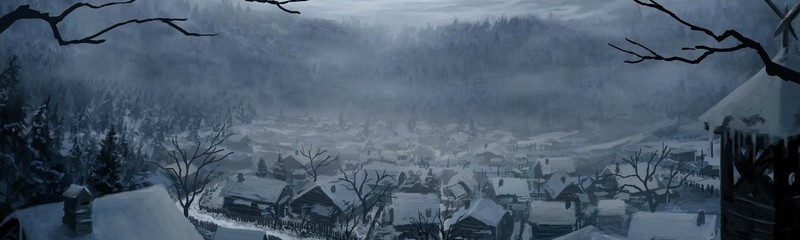
A view over the town in winter

Wednesday, June 19, 2013

Re-stocking the Temple

"Any group of humans or small humanoids within the dungeon is able to replace its losses (to adventurers) at the rate of one per day. Larger humanoids (3 + 1 or more Hit Dice) can replace one each three days; monsters can replace their numbers at the rate of one per week.
If the Temple forces are not heavily pressed by the party, they actually grow at the rates given above." - Temple of Elemental Evil, by Gary Gygax and Frank Mentz
I feel comfortable saying that, with Dungeon Fantasy's different off-time pacing, this would be downright murder on a party. You go back to town for a week and the dungeon is back at full strength! Well, at least the parts you visited are. The other levels? They're stronger. Enjoy!

No, thanks. So, what to do? After all, the dungeon should restock and change at least somewhat. At the same time, I can't reveal everything here, because I have at least one player who reads this blog.

First is to split the dungeon up into sections. Rather than restocking the dungeon as a whole, I think it makes more sense in this case to treat different parts of the dungeon as different groups. Decide what geography belongs to which groups, and note down whether a given group has a particular character - for example, one group might be composed more of brigands and normal demi-humans, while another might lean toward subterranean monsters, and a third toward  undead.

Each section should have a source that can be dealt with by PCs. This could be a single leader, an inner cabal, an attractive resource, or whatever. If something happens to the source, the members of this section either desert or join another section over the next week. Assume that half the remaining members desert regardless, and that the other half is split between compatible factions that have room. By 'compatible' I mean that the section doesn't have an emphasis contrary to the emphasis of the section it's poaching from; brigands are unlikely to join eldritch horrors. Special cases (e.g. conversion of those brigands into skeletons for the undead section) are at the discretion of the GM.

Then, for each section, decide how much capacity they have, and where they are now in filling that capacity. This is probably most easily done by counting empty rooms that could be turned into full rooms and fudging a bit for dungeon backstory. The Temple was sacked fifty years ago; at that time it was a major force of evil in the land. Lots of structural damage was done, and the Temple is nothing like what it was once. Knowing that, I'm going to eyeball it and say that most or all of the sections are at 80% capacity. This means both that each group of creatures could grow by 1/5th before being at capacity, but also that 1/5th of the number of populated rooms is how many empty rooms could be used to house new recruits. (Example: let's say section 1 has 20 populated rooms and 33 not populated. This means that 4 of those empty rooms could have recruits move in.) Once a section is at 100% capacity, it won't grow any further. (If you like, continue to roll to restock and instead of adding replace monsters.)

Each section can also have modifiers on either the Restock Chance or the Restock Roster table. For example, one section in the Temple has a Restock Chance modifier of -1 but a Restock Roster modifier of +6.

Once you've done all that, roll weekly on the table below:


Restock Chance
Roll (2d6)Result
2Catastrophe! Roll twice on the restock table and lose that many forces.
3-7No change
8-9Roll once on the restock table. Recruit for losses only; do not gain extra forces.
10-11Roll once on the restock table.
12Roll twice on the restock table.


Restock Roster
Roll (1d6)Result
0Appropriately-sized group of local fauna moves in. (E.g., horde of rats, 1 bear)
11 easy to find recruit. (E.g., 1 brigand)
21d6 easy to find recruits.
32d6 easy to find recruits, or 1 uncommon recruit. (E.g., 2d6 orcs, 1 gnoll)
41d6 uncommon recruits and 1d6 easy to find recruits.
5Either 2d6 uncommon recruits or 1 rare recruit, and 1d6 easy to find recruit. (E.g., 2d6 ogres or 1 werewolf, plus 1d6 brigands)
6Roll twice more.
71d6 rare recruits and 1d6 easy to find recruits.
81d6 rare recruits, 1d6 uncommon recruits, and 1d6 easy to find recruits.
91d6 rare recruits, 2d6 uncommon recruits, and 1d6 easy to find recruits.
102d6 rare recruits, 1d6 uncommon recruits, and 2d6 easy to find recruits.
112d6 rare recruits, 2d6 uncommon recruits, and 3d6 easy to find recruits.
122d6 rare recruits, 3d6 uncommon recruits, and 3d6 easy to find recruits. Alternatively, 1 unique monster.


Any new group will have only their own equipment and pocket-change as treasure, along with whatever was already in the room. (Plug for Dungeon Fantasy Adventures 1: it has a random pocket-change loot table in the back.) However, any new group that gets another batch of reinforcements will have appropriate treasure, to represent their successes.

Feel free to assign modifiers, especially to the second table's roll. If a section is particularly strong or well-known, it should get plusses, as everyone wants to join the winners. A weak section should get minuses. There might be situational modifiers as well - for example, the Cult of Our Aquatic Masters might get a hefty bonus after a local flood. 

Consequences of Success


What happens when the PCs knock out a section? For 1d6 weeks, nothing. That area remains deserted. After that time is up, roll another d6. On a 6, a new faction takes up residence; make it roughly as strong as the surrounding factions. This can either be a completely new force, or defectors from the other factions making common cause and setting up their own power base. On any other roll, divide the empty area between the nearby factions. This will probably be a roughly equal division, but if one faction is significantly stronger than the others it might claim more. Move one or two groups from their current places in the section to the new area, but otherwise wait on restock rolls to add recruits.

Notes


The tables above aren't organized by foe difficulty, but instead by ease of recruitment based on the fuzzy factors of likelihood of joining the cause and the population of the realm around the dungeon. "Easy to find" doesn't mean "mook" and "uncommon" doesn't mean "worthy", though the categories probably roughly track one another. This reflects my bias that the behaviour of the world should track only loosely with the capability of the PCs. If you disagree, the wording is easy enough to switch, I think.

Where did these numbers come from? Nowhere. I thought them up out of the blue. If you're inclined, please playtest this and give me feedback, but use at your own risk. Still, I hope it's helpful, and I did at least familiarize myself with the probabilities involved beforehand.

Also, as an aside, does anyone know how to make tables in Blogger without editing the HTML? I'm fine with doing that, but it'd be nice if I needn't.

Tuesday, April 30, 2013

Nulb set pieces: Cugel the Sage

Down the main way along the river a bit from the Boatmen's Tavern is an old ramshackle hovel hung with crude trinkets that glitter and jingle in the wind and rudely scrawled over in faded red paint with "Cugel the Wise". It's not much to look at, and neither is the proprietor.

Cugel is usually clean, but he smells and looks of poverty, his clothes mostly rags except for his hat, which is a nearly ridiculously large and floppy thing with a very gaudy hatband ornament that looks like a piece of cheap mother-of-pearl. His wares are almost without exception trash, though he swears up and down they're potent magical charms of all sorts - against illness and scrying and for love and against magics, etc. etc. If someone were to actually take the time to poke through all of it, and had an eye for such things, he just might (5 or less on 3d6) find something of actual value, though Cugel is unlikely to part with it without charging far more than its worth.

Cugel is a rat and a scoundrel who spends most of his time and money at the Boatmen's tavern cheating at cards and shilling his useless trinkets to the gullible. However, one thing he does have is information, and pretty much all the natives will vouch that, in this particular, he is both accurate and honest.

Given a day and $100, he will answer any question about the Temple and its surrounds. His answers won't always be complete, and very seldom they will be, "I don't know," but they will always be accurate.


Cugel's relevant skills, if they need to be rolled for some reason instead of just giving the information, include:

Area Knowledge (Temple of Elemental Evil) - 18
Hidden Lore (Temple of Elemental Evil) - 14
Hidden Lore (All other specialties) - 16
History (Temple of Elemental Evil) - 18

A note on price: I'm trying to set a price that's low enough Cugel might be approached, but high enough the PC's won't just dump cash on all their problems. It's open to adjustment, especially based on the local economy.

Wednesday, February 27, 2013

Communicate the Threat

Spurred by a long comment by one of my players on my first after-action report, I've come to realize that there are a few specific things I can do better both for my enjoyment and for the enjoyment of my players.

As I said before, I'm interested at least on some level in what I'll call "tactical play"; that is, in making combat and the exploration of the dungeon that interfaces with it into a realm of interesting, relevant choices.

There are a few prerequisites for this to work. The first is that communication of the tactical reality is clear. Decisions made without input aren't decisions; decisions made on faulty input aren't meaningful.

This is in fact one of the great boons to using monsters straight out of the monster manual, and also potentially one of the great sticking points for a conversion. It's obvious to anyone who has played D&D for more than one session that goblins are less dangerous than gnolls, and bugbears trump both. You don't mess with a dragon unless you brought serious firepower. Medusae are a sticky business. And so on. So, one of the goals of my conversion should be (and is, to a large extent) to preserve at least the relative threat-level these monsters present. When PCs meet an ogre, they should expect a tougher time than they had with the three kobolds in the last room. (Especially with large NPCs in GURPS, this is difficult but not impossible.)

Let's take an example where this broke down: the frogs outside the Moathouse.

Giant frogs aren't immediately evident as big nasty creatures. The mere fact that they're simply dire versions of animals tends to put them on a lower rung than, say, evil humanoids or the undead. Without other input, their threat assessment is inferior. However, that's clearly not the case. So, what could I have done, as a GM, to properly establish that this encounter was meant to be dangerous?

First, let's talk about what I did do. I made it very clear, several times before our first session, that without smart play this could very well turn out to be a high-mortality game. Also, I helped with character creation as much as I could in the communal format we used, and tried to make it clear that there was a vast difference in combat performance between roles specialized for it (like the Knight or Barbarian) and those not (like, say, the Scout).

...but that's it.

I gave them no useful information about this specific encounter, save that a) they're giant, dog-sized and larger frogs, and b) they're ravenous and will attack without quarter. (I believe I very clearly quoted from the book there, because it amused me.) So, quite naturally, my players assumed this might be a bit sticky, but that they would probably walk over it with only some little difficulty.

Those of you who know T1 know that's not true. The book is very clear - this is throwing the characters in at the deep end. So what could I have done, proactively, to make that clear, especially to players new to  tactical play?

First, there should have been more environmental clues. Bones near the pool, divots in the road, or generally something to indicate that they are now in dangerous territory.

Second, I can and should specifically call for rolls vs. the appropriate monster-recognition skills, Naturalist, in this case, and then given the PC(s) with those skills the rundown on these monsters. "Oh, these particular frogs have the dark-blue spotted backs of the Greater Voracious Lump-Backs - very dangerous, even to a patrol of armed men, especially in large numbers!" (Or whatever.)

Third, if in my judgment the encounter is liable to go completely foul without some crucial bit of knowledge, I should just straight-up give it to the players. "Guys, these frogs do 1d+1 cr with their tongues some can swallow SM+0 creatures. Also, there are six of them." Realism be damned if it leads to a bad night. (Note: I don't think we had a bad night. Actually, it seems like everyone had fun, even if the Scout's player is a little disappointed in his character's already-imminent death.)

None of this is the same as coddling the players or playing in easy-mode. In no case would I give away information that would reduce the necessity of my players to make decisions as to how to achieve their goals. Also, if surprise is an essential element of the encounter, so be it - you wouldn't know that bugbear is hiding in the rafters because you didn't look hard enough and he's sneaky, sorry. However, when that bugbear makes himself evident, unless bugbears are meant to be some strange exotic creature people have never heard of, the players should know - even if I have to straight-up tell them - that bugbears are almost as strong as ogres and are smart enough to use guerilla tactics.

Monday, February 18, 2013

Rumormongering in Hommlet and Nulb

Ah, rumours. That venerable conceit, that ingenious method of imparting information to the players. Rumours are true, rumours are false. Rumours come on tables and charts, they come in the form of maps, they come from the old man in the tavern and the city guardsman who used to be an adventurer, before he took an arrow to the knee.

One thing you should realize up front: I'd never heard about rumours and their mechanics before discovering the OSR.

Sure, I knew the old rag about the old man in the tavern. I even purposefully started a campaign that way once. But quests are different from rumours. Before I found the OSR, I had never even considered rumours as existing, much less the mechanisms of their dispersal or their uses and pitfalls.

I don't know how this happened. Certainly it has something to do with never playing a version of D&D before 3.5, though I'm kind of surprised I didn't pick it up in the AD&D books on my father's shelves that I spent hours with.

Okay, no, I'm not that surprised; I was mostly into them for their cool pictures, especially of monsters. I was so into the monsters I actually read their descriptions.

Anyhow, now I'm in the position where I want, nay, need to give rumours to my players. So what do I do?

Obviously, I construct a rumour chart and roll a d20 (or d30), and for getting fancy I allow carousing to increase the chance or number of rumours you get.

So let's talk about Hommlet. Hommlet is a small town that mostly wants to keep its head in the sand, with some bad elements mixed in trying to tear things apart. The townsfolk don't know much and they don't want to know much about the Temple; sure, there are some folks that do, but the PCs should be talking directly to them instead of just rolling on a chart if they want that information. Information that should come from specific sources shouldn't be part of a rumour mill.

What sorts of rumours can they pick up in Hommlet, then? The Moathouse is right down the way; most everybody knows about it and knows at least a little of its history. Those living on the southeast side of town might know a little about the comings and goings thereabouts, but not much. The villagers' information on the Temple of Elemental Evil is even more sketchy. Talking to Burne or Jaroo directly might yield fruit, but just drinking at the inn isn't going to get you much more than the hopeful talk of other adventurers.

If the PCs spend the week in Hommlet, they don't get a rumour for free. Carousing can get you one rumour, though.

Nulb, on the other hand, is a hotbed of activity. Seriously, just look at the banner; you've never seen a more wretched hive of scum and villainy. (Unless you're a Martial Artist who took the Wizard lens. Then, maybe.) PCs who stay in Nulb get one rumour for free. If they carouse, for each two points they succeed by, they get another, until the chart's dry for that week.

Simple. Easy. Another distinction between the two villages. I might even institute a Nulb-specific "if you fail at carousing, something bad happens" chart, though not as severe as that link, methinks.

Wednesday, January 9, 2013

Random Encounter Tables: Adventuring around Nulb

I needed to get to these eventually. The Temple of Elemental Evil has some random encounter tables for adventures taking place in the wilderness around Nulb. These are useful, if a bit cursory, for getting a feel for the place. It includes tables for woodlands, swamp, and river adventures. In addition, they're useful for overland travel between Hommlet and Nulb, and I imagine I'll mostly be using them in that respect, though if I get truly grandiose ideas I may create another couple mini-dungeons for the PCs to visit, so the players have some choice. (However, I figure a large part of that strategic choice is made when they come to the table. They know I'm running a romp through the Temple of Elemental Evil, and it's not like I'm the only game in town.)

Without further ado, here they are:

Nulb Encounter tables (roll 3d6)

Scrub/Forest/road (9 or less, roll twice per day and twice per night, double that if off-road):

00-10:    Wild boars (1d6-3 minimum 1) (roll 1d6; on a 1, this is a herd consisting of 1d6 x 30 adults)
10-25:    Wolves (3d10; roll 1d6, on a 1, substitute dire wolves from DF 2 instead)
26-30:    Day: Scouting/hunting party of elves (3d6)
              Night: Werewolves (1d4; alternatively, a different 'were' if you like)
31-45:    Gnoll band (4d10)
46-60:    Bugbears (1d10)
61-70:    On road: small merchant caravan (1 in 6 chance of being diguised evil pilgrims)
              Off road: Bandits, as below
71-90:    Bandits  (4d6) (outfitted like Nulb militia and probably are)
91-99:    Roll twice more
00:         Special, roll on the Specials table


Swamp/Pond/Road (9 or less, roll twice per day and twice per night, double that if off-road):

00-15:    Giant frogs, 1d10 as per the moathouse
16-20:    Day: Giant snake
              Night: Ghouls, (2d6 led by 1d6-3 ghasts - like ghouls but with 3-hex nauseating aura and +1 vs.
              turning)
21-30:    Leaping Leeches, effectively infinite. If you need a precise number, roll 1d100 x 100
31-45:    Wolves, (3d10; roll 1d6, on a 1, substitute dire wolves from DF 2 instead)
46-60:    Gnoll band (4d10)
61-70:    Toxic Slorn, (1d6)
71-80:    On road: small merchant caravan (1 in 6 chance of being diguised evil pilgrims)
              Off road: bandits, as below
81-90:    Bandits  (4d6) (outfitted like Nulb militia and probably are)
91-99:    Roll twice more
00:         Special, roll on the Specials table

Specials:
00-05:    Large Merchant Caravan (PCs may trade at the caravan for normal prices, everything except
              non-perishable magical goods, e.g. magic swords and armor or artefacts)
06-10:    Horde pygmies (1d10 x 10)
11-20:    Orc raiding party (1d6 x 15)
21-25:    Wyverns (1d6)
26-35:    Slugbeast
36-45:    Stirges (5d10)
46-56:    Day: Dryad
              Night:
56-65:    Trolls, 1d6-2, minimum 1
61-65:    Giant Ape
66-75:    Hunting party from the temple, roll 1d6:
              1-4: Humans (5d10), packing earth temple robes and outfitted like guards (chain and shield,
              crossbow and broadsword)
              5: Bugbears (2d6) packing fire temple robes and outfitted like guards (chain and shield, bastard
              sword or mace)
              6: Humans (2d6) w/ orcs (2d6) packing water temple robes and outfitted like guards (chain and
              shield, bows, crossbows)
76-85:    Another adventuring party
86-90:    Ogres, 2d6
91-00:    Batchala flock, 3d10


Also, I apologize to anyone on a mobile device or non-standard resolution. I had to format these by hand with spaces,because Blogger doesn't have table support except in the HTML mode, which I'm far too lazy to wrangle with at the moment.

Thursday, December 27, 2012

Happenings in Hommlet

I made this very simple relationship map as a quick-and-dirty explanation of how various different people in Hommlet connect with one another. It doesn't include everyone, just everyone I thought might be interesting to put on such a map. (For example, the braumeister and cabinet-maker aren't on this map; they're just subsumed under 'Townsfolk'.)

I'm using it as a loose who-gets-involved indicator. So, if Burne gets in trouble somehow, natural responders might be the Badgers, Rufus, the clerics of Cuthbert, and the village elder (and through him the militia or other townspeople).

There are some things not shown on the map, too. For example, Black Jay is the villager whose wife and child were killed while he was away during 'the wars', which I'm spontaneously deciding means they were killed by agents of the Temple during a raid from the Moathouse while he was away - the wars being, specifically, the one of Veluna against the Temple. Thus, if he finds out the traders are active agents of the temple, he's liable to gird himself and go burn them out, by himself if he must. However, seeing these relationships mapped out visually like this does make it easier to both represent the individuals in Hommlet with better veracity and to draw up a loose timeline of happenings.

Here's what will happen in Hommlet if the PCs don't interfere somehow (say, by raiding the Moathouse):
  • The traders and their agent will continue feeding information to the Temple fairly unimpeded.
  • At the same time, the agent will try to use his inside status as a member of the laborers (not pictured, whoops!) to compromise the building of Burne's castle somehow, probably by weakening the foundations or including a backdoor somewhere.
  • Within about a month, the traders will begin recruiting bandits and river pirates as laborers to work on the castle. Once there are enough, they will start using the abandoned secret room under the inn again for covert meetings.
  • Around this time, Gundigroot will notice something fishy is going on and the druid Laroo will start spending more time in the Inn.
  • The militia will get a bit edgy as well, with all the lowbrow strangers filtering in and spending a lot of time in the Welcome Wench.
  • After another month or so, a mysterious fire will catch in the Church of St. Cuthbert, razing it with only one survivor, who dies under the ministrations of the druid after spending a few nights in a fever-dream about 'evil in the flames'.
  • The militia will institute a curfew and begin patrolling the village. Burne's Badgers will tighten security around the castle. The two will not get along.
  • Nira will pack up and leave town.
  • Spuignor will sign on with Burne.
  • Fumok will disappear (off to Nulb or the temple, I imagine)
By this point, the village is still playable, but it becomes somewhat harder. Villagers are less inclined to trust strangers, and the Temple's influence is growing faster than ever. I could go further, but I don't see the point - almost certainly, the players will do something to keep anything beyond point 2 (possibly point zero) from happening. This is just a tool to make sure the village doesn't become stale.

Wednesday, December 26, 2012

Moathouse Operational

Whew. I've finished all the Moathouse NPCs, including a couple small extra surprises of my own. It helps that I could steal a few bits from already published GURPS sources. And people say GURPS doesn't have any monsters!

This still leaves treasure, of which I've already done most, and traps, which are so easy I'll probably handle them on the fly. I'd say it's ready for play, considering I already have an idea of how Hommlet is going to behave.

However, I doubt you tune in here to hear me congratulate myself, so here's a bit of musing.

Lareth's guards are naaasty. Even without a cleric backing them, they could probably destroy a party, played smartly. There are six level 1 fighters, led by a level 2 sergeant, and if they start losing they will call for the rest, which consist of twelve more level 1 fighters and two more level 2 sergeants. Yowch! Any party that just barrels forward into the combat is either going to be very lucky or very dead. If anything, this comes across more in GURPS; for example, the book says that six of these reinforcement guards have spears instead of crossbows, which naturally leads to the assumption that you will run them competently using unit tactics, with spearmen protected by your front-line shield-wall. This tactic transitions very well to GURPS, with the added benefit that a shield-wall is even more difficult to take down due to the ability to use sacrificial blocking and teamwork.

A party is going to have to be smart and sneaky to crack this nut. Oh, and that's not counting the lieutenant (a level 4 fighter) or the cleric.

Hopefully soon I get to let you know how it goes.

Wednesday, December 19, 2012

Maintaining Encounter Balance

Let me start off by making clear what I'm not talking about.

I'm not talking about scaling 'encounters' to the PCs' capabilities in anything other than a rough and ready fashion. I'm certainly not talking about some analog to CRs or other balancing mechanic designed to maintain an even level of pressure on the characters. I think that's a false idol, both unattainable and undesirable besides.

No, I mean something much simpler: D&D and GURPS consider different things to be difficult, and they favor different sorts of tactics.

D&D at its core involves tactics of resource management and attrition. Roughly speaking, the slope of the increase in hit points for a party is about twice that of the slope of damage output increase for a party. (I'm eyeballing it here; the main point is that it's proportional with some multiplier n.) In GURPS, if anything, it's the opposite; what with points for Targeted Attacks and Weapon Mastery and Heroic Archery and more damaging spells and whatnot, damage increases as about twice HP.

This is reflected in the different challenges in the two games. In D&D, in order to have a monster fight that challenges higher-level characters, you throw bigger monsters with stronger attacks at them - you're still presenting a serious threat to their resources without necessarily killing them outright, and you're pretty well guaranteed to have your monsters stick around long enough to be interesting, since they're bringing enough HP to the fight that the PCs can't get rid of it fast enough to be trivial. Conversely, in GURPS if you try this tactic, you're going to end up with a very quick fight - either the PCs will walk all over your big nasty, or you'll accidentally squish the party.

Instead, in GURPS, the general tactical layout involves multiples of smaller monsters, because smaller monsters can still pose a serious threat, and dividing up the foes divides player actions. In other words, D&D is about managing hit points, whereas GURPS is about managing actions. The side with more actions is the side with the advantage.

This is borne out by the common advice for encounter balancing in GURPS. It's often said that, if pitting the PCs against a singular large monster, you should do one or more of:
  • Give the monster Extra Attacks, always-on effects, or suchlike, thus bringing number of available actions back toward parity
  • Give the monster special defenses, such as insubstantiality or injury tolerance, thus making each opposing action less effective
  • Include environmental effects, thereby requiring that PCs spend their actions on things other than killing the monster
  • Provide tactical advantage to the monster, which reduces PC actions either entirely (e.g. surprise) or in their effectiveness (e.g. an archery battle against an enemy up-hill - which means that PCs either shoot back at minuses or spend actions closing the distance).
In my admittedly inexperienced opinion, the first option is the least effective for lengthening a fight, though it works just fine for maintaining a controllable danger level in the fight.

This is something of a problem for the Temple of Elemental Evil, which naturally assumes a D&D approach to combat tactics. For example, there are places in the modules where a single ogre (or an ogre and a wolf, later on) is put forward not only as a foe, but as very stiff opposition that the party will probably flee from. In GURPS, on the other hand, a party of 50-75pt characters can probably take out a single ogre without much difficulty - maybe one death, if the ogre gets in a lucky hit. So how to convert these?

It turns out the answer is, "only partially", at least for my purposes.

The pivot point between GURPS and D&D works both ways. There are encounters that are supposed to be very tough in D&D that the GURPS characters will walk right over. However, there are also encounters that Gygax reckons will be fairly easy for a group of 4th-5th level D&D characters that will present serious problems for GURPS characters even at 300 pts. (I'm looking at you, group of 25 bandits.) There are enough of these that I think it balances neatly enough, even if sometimes it looks like they're in the wrong places.

The other part is taking a hard look at the large monsters that the Temple favors for challenging PCs and seeing if there isn't some way to preserve some of that element. To that end, let's take ogres are our example du jour:

Ogres in D&D are fairly nasty, especially toward lower-level characters. To help preserve that, in my game, all ogres will have Magic Resistance 5. This, combined with the extra casting cost to directly affect creatures of larger sizes, should put a damper on magical solutions that don't mimic weapons or environmental effects. Further, while they're stupid, they will have a canniness that enables them to use their advantages well. They will all get Tactics-12. Specifically, while they can't really hide (even if they could find a place not to be seen, you'd still be able to smell them), they naturally pick lairs that enable them to use their reach and their greater strength to advantage, doing things like picking places with attached hallways or stairs, and piling up obstacles that create difficult footing for creatures not as large. Finally, ogres in my game have extra DR 3 over vitals and the skull, in the form of thick subdermal ridges of bone, making them look burly even for their size and giving them low, sloping foreheads with weird, angular planing. Evolution has taken advantage of this, layering on extra muscle at these reinforced attachment points, which explains their high strength.

So, in my game, an ogre looks something like this:


ST: 25 HP: 25 Speed: 6.00
DX: 11 Will: 7 Move: 6
IQ: 7 Per: 7
HT: 13 FP: 13 SM: +1
Dodge: 9 Parry: 10 DR: 2, 5 on vitals and 7 skull


Punch (13): 2d+2 cr
Club (14): 5d+3 cr (treat as oversized maul, meaning it's 0U because of strength)
Traits: High Pain Threshold, Magic Resistance 5, Night Vision 7 DR 2 (Tough Skin), DR 3 (Limited: Skull, Vitals), Bad Temper, Bully
Skills: Brawling-13, Tactics-12, Two-Handed Axe-Mace-14
Class: Mundane
Notes: Some may have armor, mostly on the chest; adjust DR accordingly. (Most common is either naked or Heavy Leather.) Willing to negotiate, but only on their level (Food, women, territory, simplistic praise), easily tricked.

Monday, December 17, 2012

Elmo, Ranger of Verbobonc

Elmo is a drunken lout the PCs find about town in Hommlet who's interested in adventure!

Okay, so not really. Really, he's a 4th-level ranger in Hommlet on orders from the Viscount of Verbobonc 'for the purpose of observing newcomers, to insinuate himself in their expeditions'. Using Collective Restraint's level guide for GURPS, I built him off 210 points.

Here's his statblock in T1:

Elmo: AC 1 (equipped) or 8; Level 4 Ranger
(HD 5); hp 41; #AT 1; D 5-12 (battle axe)
or 6-9 (dagger) each including magic and
strength bonuses); XP 375
S 18/43 I 15 W 16 D 16 Co 17 Ch 11
and also:
 If employed, he
dons his own mail (see below) in place of that
given (or under a lighter type), and uses his
own magical battle axe as well.
Elmo's valuables are hidden in a lead-
lined oaken chest buried in the dirt floor of
the barn: chain mail +1, shield +2, battle
axe +1, 100 sp, 50 gp, 10 pp, and and small
pearls worth 100 gp each. The lead will foil
all attempts at magical detection. He also
owns a longbow with two score arrows,
half of them silver-tipped, though he does
not bring this weapon on adventures.
This guy is serious! Look at those stats! Also, as someone who never played AD&D, it was at first a surprise to me that he'd leave his bow at home. After all, rangers are ranged weapon folks, right? Of course I was wrong, and pleasantly so; rangers in 1st edition seem much closer to the source material, being fighters with some wilderness experience. Here's the character sheet.

Update: It has been asked what Elmo's role would be in my game. Really, I should have included a piece on that here without prompting, but it slipped my mind.

Elmo will try to latch onto the PCs and go adventuring with them, attempting to make himself attractive first as a hireling, then as a cut-rate fellow adventurer. He'll go so far as to take only a half-share of the treasure, if need be, to induce them to take him...which should make the players suspicious, but what's a King's spy going to do? At any rate, if they don't take him along, he'll shadow them into the dungeon, coming forward to aid them if they look like they need it and are worth aiding, or making their lives difficult if they seem likely to be working for the Temple.

Specifically, he could become a thorn in their collective side if they ally themselves with Lareth, or if they seem too willing to work for the traders. Also, he offers a way to help the party come to grips with the deeper plots surrounding the village, especially if he goes adventuring with them - an observant party will quickly see through his ruse of incompetence once actually in the dungeon.